Showing posts with label Sanderling. Show all posts

Friday, February 27, 2015

Laughing Gull

Over the years I have seen a number of rare birds in Britain including three American Laughing Gulls; two adults in Norfolk in the nineties and a second summer bird in North Wales ten years ago. So I was unlikely to travel very far to see another one, that is unless one turned up near my home, and that is exactly what happened a few weeks ago!
I live three miles from New Brighton on the Wirral, so when a group of visiting birders from Manchester found a Laughing Gull on the marine lake in the resort I dashed to the site at the first available opportunity. For the first few days the bird was quite mobile and when I arrived it was feeding near the lighthouse on the incoming tide at a distance of over half a mile away. Luckily it took to roosting on a pontoon on the marine lake that is regularly used by wading birds as a safe place to rest over the high tides.
Birders often talk about the tameness of a bird (especially gulls) by saying "it was coming to bread". Well there was plenty of bread on offer on the pontoon, but some enterprising individuals had sprinkled a few shrimps on the wooden platform and these tasty morsels proved irresistible to the vagrant gull. At times it came closer than any other bird on the lake, providing birders and photographers with unrivalled views.
Now I know that gulls are not every wildlife-watchers cup-of-tea, but I have to confess to being a bit of a larophile (lover of gulls!). So that even in its drab first winter plumage I found it to be an immensely interesting bird. The adult birds with their black hoods and dark grey backs and wings are most attractive. Hopefully this bird, which still exhibits some brown juvenile feathering, will stick around and develop more of a black hood. It is still present three weeks after being found.
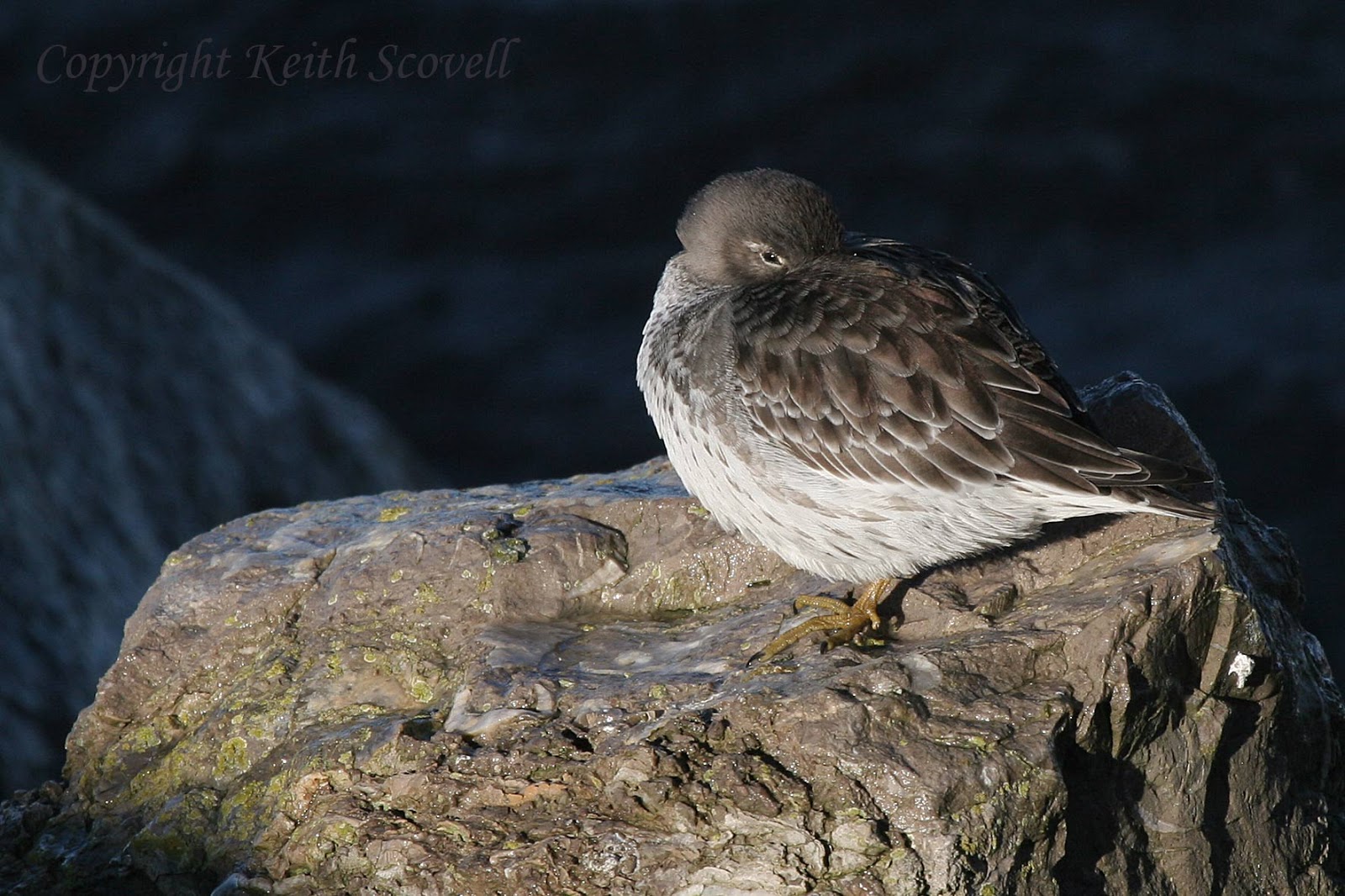
Another popular bird that frequents the pontoon at this time of the year is the Purple Sandpiper. This scarce dumpy wader is found on rocky coasts and is something of a speciality on the Wirral, with birds regularly spending the winter on the northern coast and on Hilbre Island in the mouth of the River Dee. There were at least a dozen of these roosting on the pontoon when I was photographing the  Laughing Gull. Also present was a solitary ghostly-white Sanderling. All in all it was an excellent morning spent close to home.


Purple Sandpiper

Sanderling

Redshanks and Turnstones


Cormorant


First-winter plumaged Herring Gull


Saturday, July 7, 2012

Norfolk

It's been a while since my last post so I've got a lot of catching up to do. At the beginning of June I spent a few days on the North Norfolk coast based at Salthouse. Norfolk is the premier mainland county for birdwatching, but as with recent months the weather was not conducive to birdwatching or photography. Nevertheless I managed to see or hear 94 species of bird and 8 species of mammal; not bad considering the rain (it was the Silver Jubilee weekend for those of you that braved the weather in the early part of June).
Unusually for Norfolk at that time of year rare birds were thin on the ground, the only rarity of note during my stay was an elusive Black-winged Stilt at Cley. Even the Nightjars on Salthouse Heath failed to show on 3 different nights. But I did manage a view of a Cetti's Warbler, a bird definitely more often heard than seen. The one day that the sun shone I drove to Strumpshaw Fen but no Swallowtails or Norfolk Hawkers were on the wing.
I'm sure my next trip to Norfolk will be more productive; it's a fabulous county even in the rain!

This Red-legged Partridge was in the car-park at Cley.
The rain forced this Swift to feed low
over the lake at Holkham Hall.
The rain eventually did stop allowing birds such as this Barn
Owl to hunt.
A beautiful example of mimicry; this Wasp Beetle was
photographed at Strumpshaw Fen RSPB.
Summer-plumaged Sanderling at Titchwell RSPB.
Summer-plumaged Sanderling.
Avocet feeding at Titchwell RSPB.
Avocet, Titchwell.
Breeding-plumaged Little Egret at Cley,
it was being mobbed by a Lapwing.
Juvenile Robin at Titchwell waiting to be
fed by its parent.
A flock of Spoonbills at Cley. They were easier to see than the
Black-winged Stilt.
A female Broad-bodied Chaser basking in some rare sunshine.
I tempted the Jackdaws at Blickling Hall with some fruit cake.

Jackdaw at Blickling Hall.

A soggy Little Egret manages to catch some lunch at Cley.


Saturday, January 21, 2012

Wind and Waders

Another blustery day. Left the house at 9am on a training run. Made very slow progress down the main roads to Meols, but speeded up a lot once the wind was behind me on the prom. Lots of gulls flying into the teeth of the gale and good numbers of waders including large flocks of Oystercatchers in flight and on the beach at  Leasowe. A nice flock of Ringed Plover was on the sea defences at Moreton, but the highlight for me were my first Sanderlings of the year on the beach at Wallasey.
Managed 17 miles at 7.15 min/mile pace, despite being hit by a few a few large waves!

Sanderling at Wallasey (2008)


Didn't see any Purple Sandpipers today, they were probably
all on the pontoon on New Brighton marine lake. This is a
photo from by the Coastguard station in Wallasey (2006).