Showing posts with label Redshank. Show all posts

Thursday, July 9, 2015

Snowdon and Conway

In one week's time I will be taking part in the International Snowdon Mountain Race, a fell race that runs to the top Wales' highest mountain via the Llanberis path. Although I have competed in this race twice before I am not a pure fell runner and definitely need to train on the route, so last week I drove to beautiful Snowdonia and ran slowly to the summit.

View from the summit looking towards Llanberis (iPhone photo)
 
Despite it being a warm July morning there were not a lot of people on the mountain, which at times can be as busy as the proverbial Piccadilly Circus. The summit was shrouded in cloud so I had to pause for a few minutes to take a photograph, that's my excuse anyway! The run down was a breeze, and I was soon enjoying my picnic lunch overlooking the calm waters of Llyn Padarn.
I had a number of options planned for the afternoon, if I had been very warm I had planned a wild swim in the plunge pools on the Watkin Path, but the skies had become overcast and the temperature had plummeted from the mid-week record breaking highs. Likewise, looking for Silver-studded Blues on the Great Orme or Keeled Skimmers near Betws-y-coed were both dismissed due to the lack of sunshine. So I headed for Conway RSPB reserve which is often a good place for seeing Stoats.
By the time that I was pulling into the reserve carpark the wind had strengthened and rain was beginning to fall; not ideal conditions for watching wildlife. Undeterred, I strolled down the estuary path carefully watching for any signs of Stoat activity. The tide was in and there were plenty of waders roosting on the main reserve. From the hides I could see flocks of Oystercatchers and Redshanks waiting patiently for the tide to turn. A few Little Egrets were feeding on the pools; I remember when this bird was a real rarity. I travelled to Fford Bay near Caernarfon, not that far from Conway, in 1987 to see my first ever Little Egret, how times have changed.
I was not successful in my search for Stoats but an afternoon watching the birds was more than enough consolation.
 
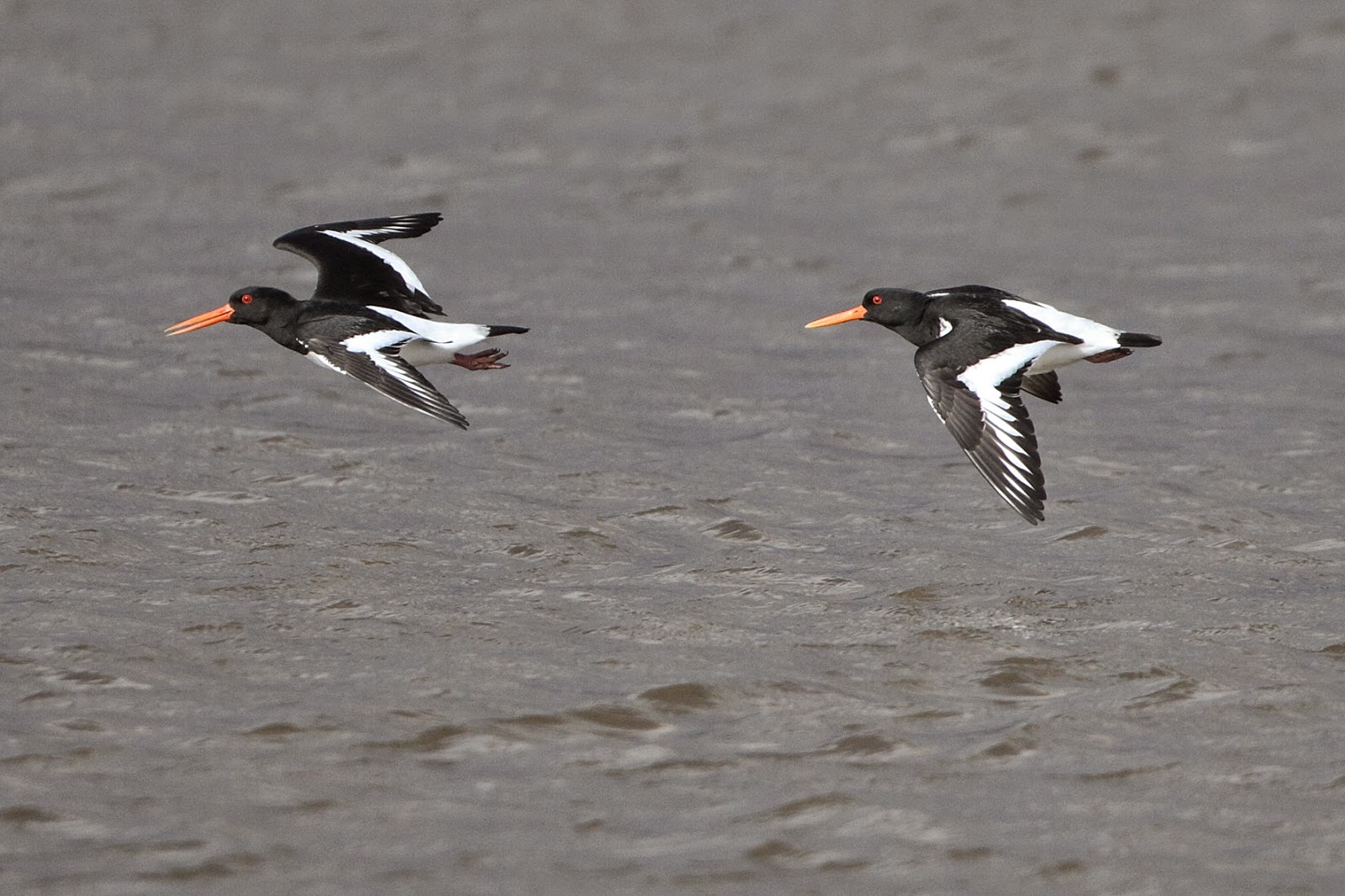
Oystercatchers heading to the estuary


Shelduck (note the rain splashes on the lake)

Oystercatcher acquiring its white winter throat collar


And just to prove there are Stoats at this site, here are two photos that I took two years ago.


Sunday, March 22, 2015

Spotted Redshank and Other Waders.

On a recent visit to Leighton Moss RSPB I had hoped to photograph some Avocets that had returned to the Eric Morecombe pools. Unfortunately, they were feeding on a very distant pool and were only just visible through my telescope. But, as always, there is always something of interest to photograph, and when that other something is one of my favourite waders, a Spotted Redshank, I am more than happy. This elegant winter-plumaged bird fed at times in the company of a Common Redshank, so it was also a good opportunity to study the differences between the two species.
It was a blustery day, and most of the other birds were sheltering from the wind, but Curlew, Oystercatcher and Little Egret all came into photographable range.
Another bonus was the presence of a small group of European White-fronted Geese in a field near the level-crossing. These were probably feeding up on the first leg of their migration back to their breeding grounds. I finished the day off on the main reserve where a unusual pair of Great-crested Grebes were showing interest in one another; unusual because one of the pair was still in winter-plumage. I had hoped they might indulge in their beautiful mating ritual, the famous "weed dance", but maybe they were not quite ready for that.
Also the resident pair of Great Black-backed Gulls that nest on the island opposite the Public Hide were displaying to one another. Although at one point one of the birds almost landed on a lapwing that was also asleep on the island!


Spotted Redshank (left) and Common Redshank


European White-fronted Geese
Black-headed Gull


Friday, February 27, 2015

Laughing Gull

Over the years I have seen a number of rare birds in Britain including three American Laughing Gulls; two adults in Norfolk in the nineties and a second summer bird in North Wales ten years ago. So I was unlikely to travel very far to see another one, that is unless one turned up near my home, and that is exactly what happened a few weeks ago!
I live three miles from New Brighton on the Wirral, so when a group of visiting birders from Manchester found a Laughing Gull on the marine lake in the resort I dashed to the site at the first available opportunity. For the first few days the bird was quite mobile and when I arrived it was feeding near the lighthouse on the incoming tide at a distance of over half a mile away. Luckily it took to roosting on a pontoon on the marine lake that is regularly used by wading birds as a safe place to rest over the high tides.
Birders often talk about the tameness of a bird (especially gulls) by saying "it was coming to bread". Well there was plenty of bread on offer on the pontoon, but some enterprising individuals had sprinkled a few shrimps on the wooden platform and these tasty morsels proved irresistible to the vagrant gull. At times it came closer than any other bird on the lake, providing birders and photographers with unrivalled views.
Now I know that gulls are not every wildlife-watchers cup-of-tea, but I have to confess to being a bit of a larophile (lover of gulls!). So that even in its drab first winter plumage I found it to be an immensely interesting bird. The adult birds with their black hoods and dark grey backs and wings are most attractive. Hopefully this bird, which still exhibits some brown juvenile feathering, will stick around and develop more of a black hood. It is still present three weeks after being found.
Another popular bird that frequents the pontoon at this time of the year is the Purple Sandpiper. This scarce dumpy wader is found on rocky coasts and is something of a speciality on the Wirral, with birds regularly spending the winter on the northern coast and on Hilbre Island in the mouth of the River Dee. There were at least a dozen of these roosting on the pontoon when I was photographing the  Laughing Gull. Also present was a solitary ghostly-white Sanderling. All in all it was an excellent morning spent close to home.


Purple Sandpiper

Sanderling

Redshanks and Turnstones


Cormorant


First-winter plumaged Herring Gull


Sunday, February 17, 2013

Short-eared Owl

Mid-afternoon yesterday saw me mingling with the masses in New Brighton, but unlike the shoppers and general public enjoying the first sunny day for some time, I was there for one reason only; waders. Or to be more precise Purple Sandpipers. The jetty on the marine lake is a safe high tide refuge for a variety of wading birds that on Saturday included Redshank, Turnstone, a few Knot and at least fourteen Purple Sandpipers, the first I have seen this year. After a few record photographs I left the bustling cafes and shops and headed for the peace of Parkgate.
On the way I checked a few roads around Irby for Waxwings but without any luck. No sooner had I arrived in the Old baths car park at Parkgate than a ring-tail Hen Harrier drifted across the Spartina. Too distant to photograph but beautiful nevertheless. Moments later the first of two superb Short-eared Owls started quartering the marsh close to the car park; fantastic! These two birds drifted up and down the marsh for the rest of the afternoon, sometimes giving amazingly close views. At one point one of the owls drifted close and high to investigate what looked like a remote-controlled toy helicopter, but I don't know where the operator was. They would have got a shock if the owl had intercepted it!
Later a superb male Merlin perched quite close giving excellent telescope views. It was one of two seen. And the finale to an excellent afternoon's birding was a distant Barn Owl seen heading south towards the ice-cream shop!


Here the owl is investigating
the remote controlled helicopter!


Purple Sandpiper avoiding the crowd of Turnstones

Redshank

You might also like:

More owls and buntings
Norfolk